Refinance debt with Instadapp: moving a loan without closing it
Interest rates in DeFi move constantly. Refinancing lets you relocate collateral and debt to a cheaper venue in one atomic transaction — if the arithmetic works.
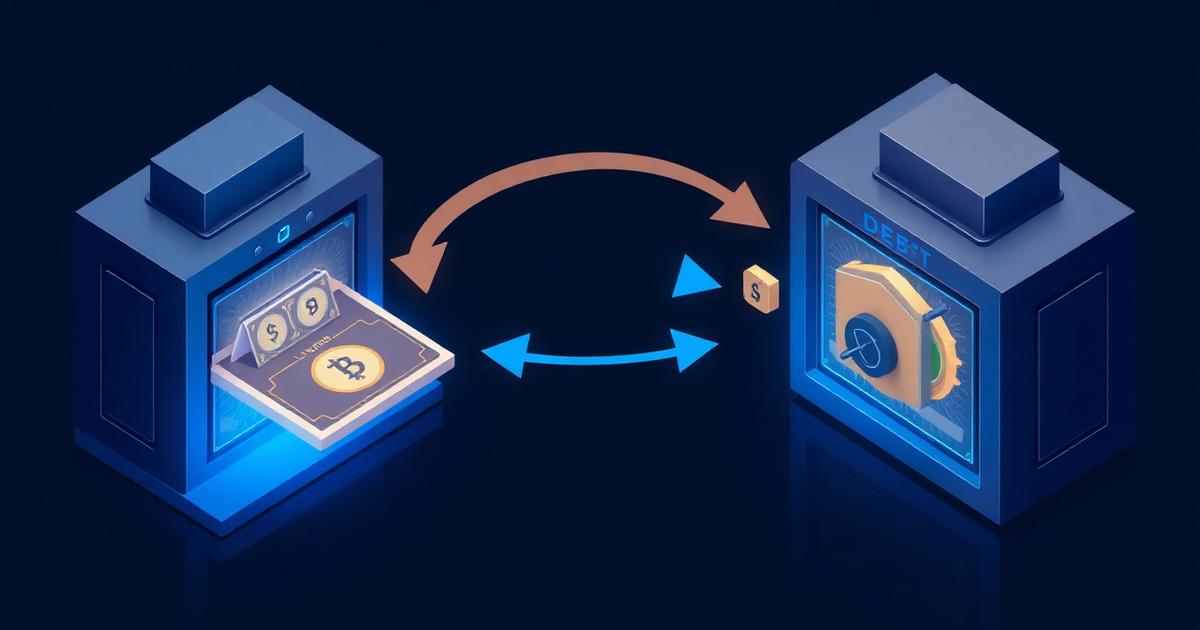
Why refinancing exists in DeFi lending
Every lending market sets its own interest rate from its own supply and demand curve. The same stablecoin can cost four percent to borrow on one protocol and nine on another simply because utilisation differs, and those numbers change block by block. A position opened at a good rate can quietly become the most expensive debt you hold.
Refinancing is the response. Instead of closing a position — selling collateral, repaying debt, buying collateral back, reopening elsewhere, paying tax and slippage at every step — you move the whole structure at once. Collateral and debt land on the new protocol in the same transaction that removes them from the old one.
How Instadapp executes an atomic refinance
The mechanism is a flash loan. The transaction borrows enough to repay your existing debt, withdraws the freed collateral, deposits it on the destination protocol, borrows the same amount there, and uses that to settle the flash loan plus its fee. Every step happens inside one transaction, so at no point is your collateral unbacked or your loan doubled.
If any single step fails — insufficient liquidity on the destination, a price move that breaches the new collateral factor, slippage beyond tolerance — the whole thing reverts and you are exactly where you started, minus gas. That all-or-nothing property is what makes the operation safe enough to run on a live position.
Calculating whether an Instadapp refinance is worth it
The saving is the rate differential multiplied by the debt, over the time you expect to hold the loan. The cost is gas plus the flash loan fee, typically around nine basis points on the borrowed amount, plus any swap slippage if assets change along the way. A two percent improvement on fifty thousand dollars of debt is a thousand dollars a year; if the migration costs a hundred, the payback period is weeks.
Reverse the arithmetic for small positions. On mainnet, a few hundred dollars of gas can consume a year of savings on a modest loan, which is why refinancing is disproportionately attractive on layer two networks or for large borrowers. Also weigh rate stability: migrating to a market whose rate is spiking for a temporary reason means doing this again next month.
Common mistakes when refinancing DeFi debt
The most frequent error is optimising for the headline borrow rate while ignoring the destination protocol's collateral factor. A lower rate with a stricter collateral factor can leave you with a materially worse health factor and less room before liquidation, which is a poor trade for a few basis points.
The second is ignoring depth. A rate is only real if the market can absorb your size; borrowing a large fraction of available liquidity pushes the rate up the moment you arrive, and your quoted saving evaporates. Check utilisation, not just the number on the screen, and re-verify the position after the transaction confirms.
How to refinance a loan using Instadapp
- 1Record the current positionNote the exact collateral, debt, borrow rate and health factor of the position you intend to move.
- 2Compare destination marketsCheck borrow rates, collateral factors and available liquidity on the candidate protocols.
- 3Estimate the total costAdd gas, the flash loan fee and expected swap slippage, then compare against the annual interest saved.
- 4Execute the migrationUse the refinance flow so the flash loan repays the old debt, moves collateral and opens the new loan atomically.
- 5Verify the resultConfirm the old position is closed, the new health factor is comfortable and no stray approvals remain.
Frequently asked questions
+Does refinancing on Instadapp require me to repay the loan first?
No. That is the point of the atomic design: a flash loan repays the old debt inside the same transaction that opens the new one, so you never need the capital to close out.
+How much does an Instadapp refinance cost?
Gas plus the flash loan fee — commonly around 0.09 percent of the borrowed amount — plus any slippage if assets are swapped during the migration.
+Can refinancing improve my health factor as well as my rate?
Yes, if the destination protocol allows a higher collateral factor for your asset. Always compare the projected health factor, not only the interest rate.
+What happens if the refinance transaction fails midway?
It cannot end midway. The transaction is atomic: either every step succeeds or the chain reverts all of them and your original position remains intact, minus the gas spent.
+Is refinancing worth it for a small DeFi loan on Ethereum mainnet?
Often not. Fixed gas costs dominate small positions, so the same operation that clearly pays on a six-figure loan can be uneconomic on a four-figure one.
Related material
- What is Instadapp? A middleware layer for decentralised financeInstadapp explained from first principles: its origins as a MakerDAO dashboard, the smart account layer, the product family today, and who the platform is genuinely built for.
- The Instadapp Pro dashboard explained, panel by panelA walkthrough of the Instadapp Pro dashboard: the overview metrics, DeFi assets list, protocol panels, balance sidebar and the automation tools that sit behind them.
- Instadapp vs DeFi Saver: which DeFi manager fits your strategy?Instadapp compared with DeFi Saver across automation, protocol coverage, simulation tools, fees and target users, including where each platform is genuinely the better choice.